

Aerospace Robotics Market for 2030: Articulated Robots to Hold 59% of $9 Billion Market at 11% CAGR
Aerospace Robotics Market Overview
Aerospace Robotics Market
Aerospace Robotics Market Size
The Business Research Company's Aerospace Robotics Market for 2030: Articulated Robots to Hold 59% of $9 Billion Market at 11% CAGR
LONDON, GREATER LONDON, UNITED KINGDOM, October 9, 2026 /EINPresswire.com/ -- "The aerospace robotics sector is set to become a significant force within the broader aerospace industry, driven by increasing technological advancements and demand for efficiency in production and maintenance. As aerospace manufacturing evolves, robotics are playing an essential role in enhancing precision, safety, and operational efficiency. Let’s explore the current market size, competitive landscape, key drivers, and future opportunities in this dynamic field.
Projected Market Size and Growth Trajectory for Aerospace Robotics
The aerospace robotics market is expected to surpass $9 billion by 2030. When placed within the context of the wider Aerospace market, which is forecasted to approach $442 billion by the same year, aerospace robotics will represent roughly 2% of this value. Zooming out further to the overall Aerospace & Defense industry, projected to reach $1,166 billion by 2030, the aerospace robotics segment will account for nearly 0.7% of total market worth.
Request A Free Sample Of The Aerospace Robotics Market Report
https://thebusinessresearchcompany.com/sample_request?id=98205079&type=smp&name=Aerospace%20Robotics%20Market%20Report%202026&utm_source=EINPresswire&utm_medium=Paid&utm_campaign=Oct_PR
Competitive Landscape in the Aerospace Robotics Industry
Leading the aerospace robotics market are a mix of global aerospace technology giants and specialized robotics providers. These companies strive to enhance aerospace production and maintenance by investing heavily in advanced robotic systems, autonomous operations, precision manufacturing techniques, and intelligent automation. Their competitive advantage is built on boosting operational efficiency, ensuring compliance with rigorous safety standards, simplifying manufacturing workflows, and integrating artificial intelligence alongside sophisticated control mechanisms. Gaining insight into this competitive environment is vital for stakeholders aiming to capitalize on growth, technological innovation, and strategic collaborations in aerospace manufacturing automation.
Major Players Driving the Aerospace Robotics Market Forward
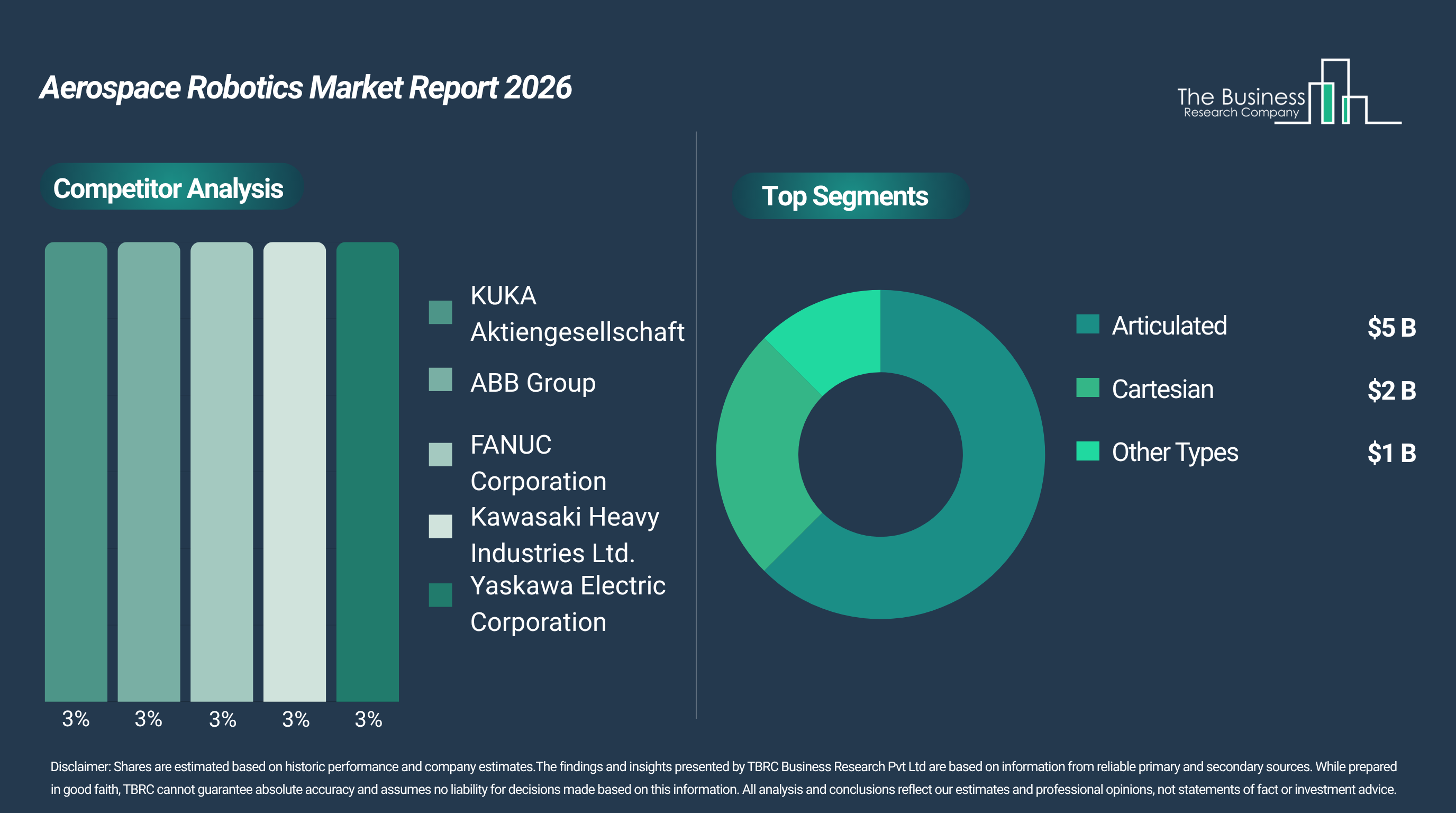
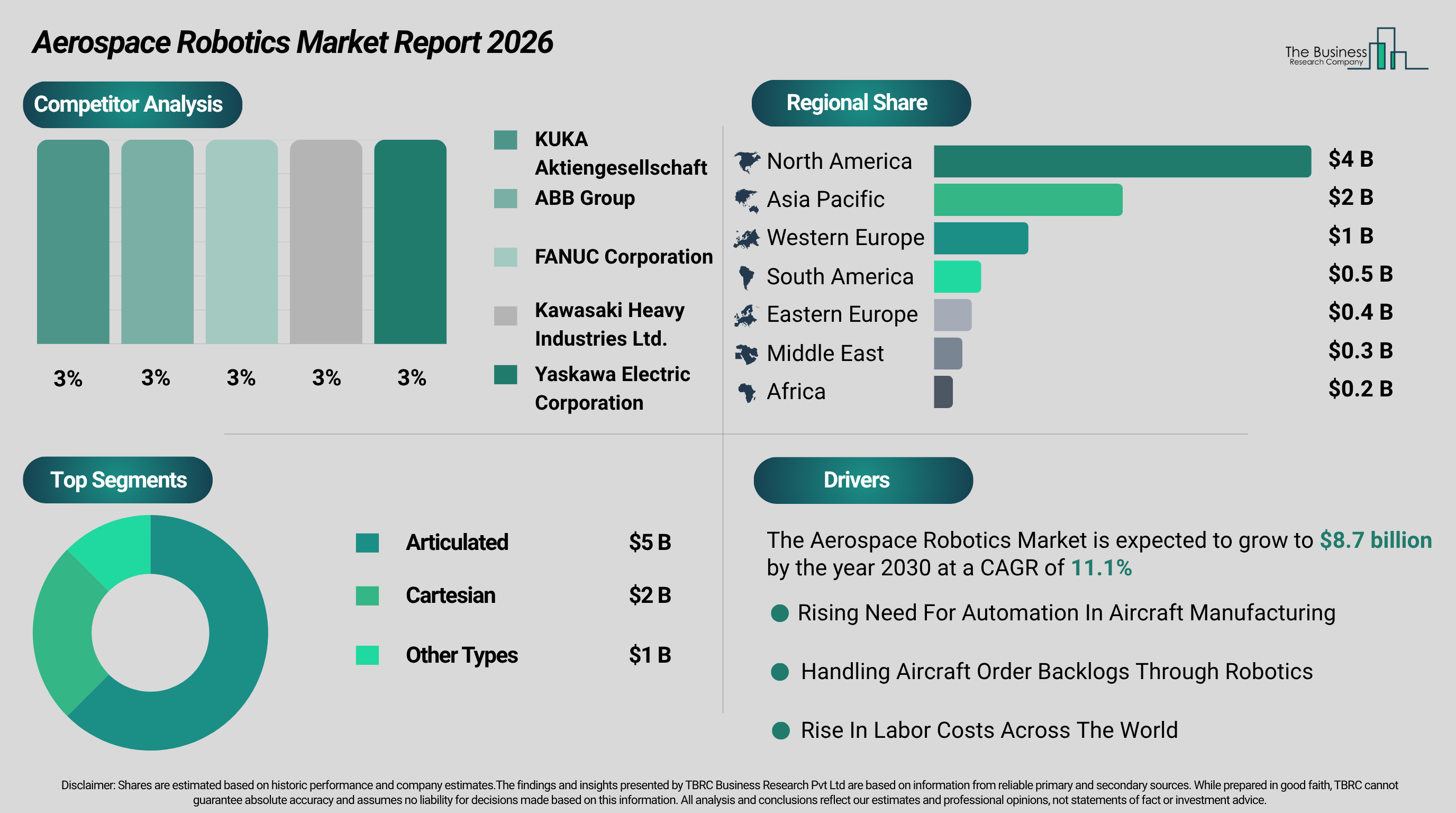
According to The Business Research Company, KUKA Aktiengesellschaft will hold the top position in global aerospace robotics sales in 2025, capturing a 3% share. KUKA’s robotics division supplies industrial robots, automated manufacturing solutions, precision robotic systems, and digital automation technologies widely used across aerospace production, assembly, inspection, and maintenance operations.
Access The Detailed Aerospace Robotics Market Report Here
https://thebusinessresearchcompany.com/report/aerospace-robotics-global-market-report?utm_source=EINPresswire&utm_medium=Paid&utm_campaign=Oct_PR
Regional Market Leadership and Growth Dynamics
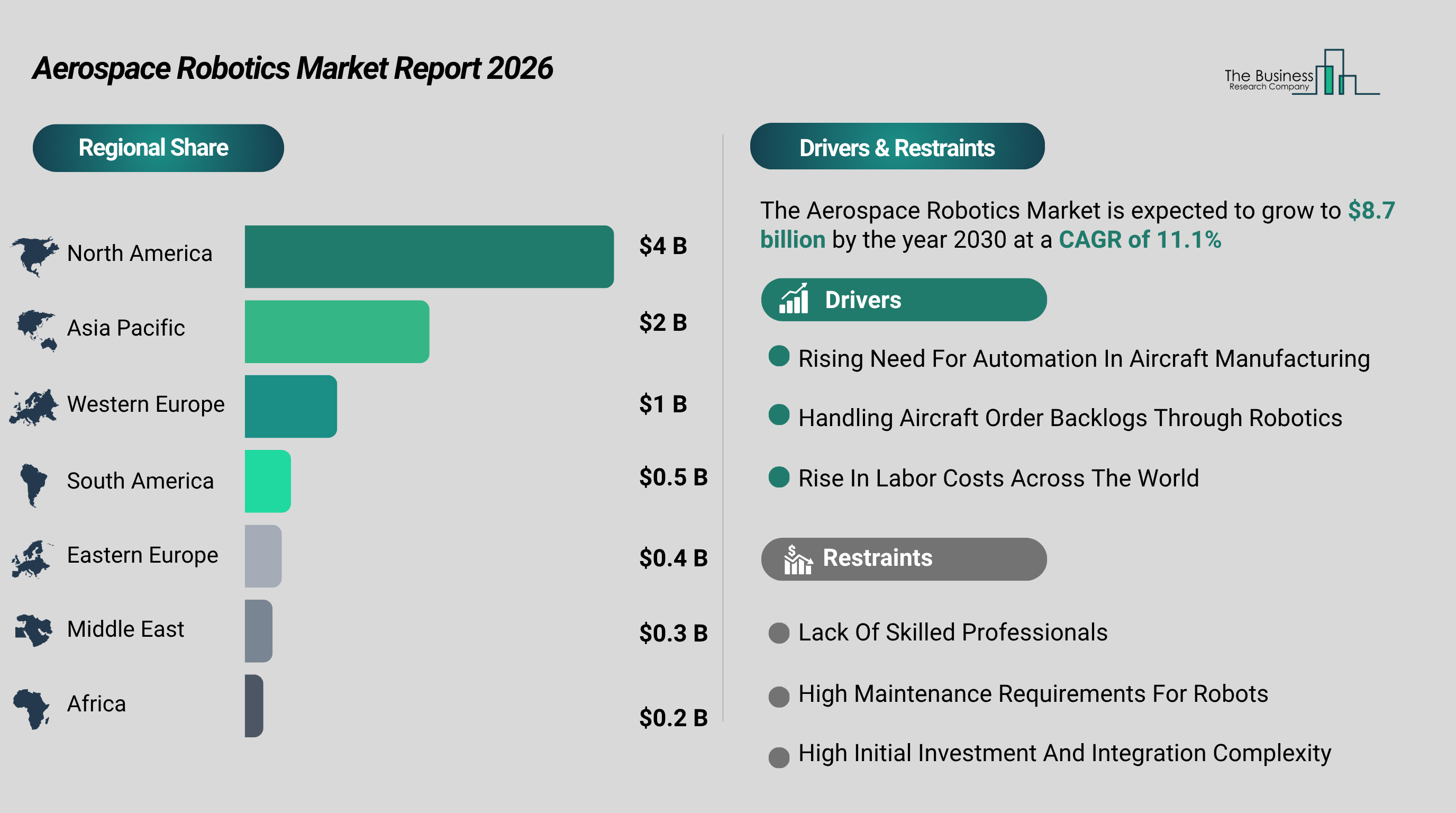
North America is projected to dominate the aerospace robotics market in 2030, with a market value of $3.7 billion, up from $2.2 billion in 2025. This reflects a compound annual growth rate (CAGR) of 12%. The region’s rapid expansion is fueled by increased adoption of robotic automation in aircraft assembly and precision manufacturing, surging production of commercial and defense aircraft to meet global demand, investments in smart factories and Industry 4.0 technologies, as well as the growing need for high-accuracy robotic systems to improve quality, efficiency, and safety on production lines.
Leading Segment Within the Aerospace Robotics Market
The market divides by robot type into articulated, cartesian, and other categories. Articulated robots are forecasted to be the largest segment by 2030, accounting for 59% of the market or $5 billion in value. This dominance is driven by demand for versatile multi-axis robots capable of complex aerospace assembly tasks, including robotic welding, fastening, and composite material processing. Additionally, the integration of vision-guided and AI-enhanced articulated robots for precision manufacturing, along with the deployment of flexible robotic cells suited for high-mix, low-volume aerospace production, will support this segment’s growth.
Further Market Segmentation Details
Beyond robot types, the aerospace robotics market is segmented by technology into conventional and collaborative robots. Component-wise, it includes controllers, sensors, drives, arm processors, and end effectors. Payload categories range from small-medium to large and extra-large payload robots. Application areas cover drilling, welding, painting, inspection, and various other aerospace manufacturing and maintenance processes.
Primary Drivers Accelerating Aerospace Robotics Growth
Three main factors are propelling the aerospace robotics market's rapid expansion through 2030.
Growing Demand for Automation in Aircraft Manufacturing
Manufacturers seek to enhance efficiency, precision, and consistency in production. Robotics systems excel at automating complex, repetitive tasks like drilling, welding, and assembly with high accuracy. This reduces human error, improves product quality, shortens production cycles, and scales output to meet rising aircraft demand. This automation push is estimated to contribute about 2.5% annual growth to the market.
Addressing Aircraft Order Backlogs with Robotics
Pressure to deliver large aircraft volumes within tighter schedules pushes manufacturers toward robotics adoption. Automated systems accelerate production by handling time-consuming, repetitive tasks, easing bottlenecks, boosting throughput, and maintaining consistent quality at scale. This factor is expected to add roughly 2.3% growth annually to the market.
Increasing Global Labor Costs Encourage Robotics Use
With labor costs climbing worldwide, aerospace companies are turning to robots to cut reliance on manual labor and improve cost-efficiency. Robots perform repetitive, precision-intensive jobs with consistent output and minimal errors, helping reduce operating expenses while preserving quality. This trend is projected to contribute near 2.0% annual growth to the market.
Market Share and Competitive Positioning of Leading Aerospace Robotics Companies
The aerospace robotics market is moderately fragmented, with the top 10 firms capturing 22% of total revenue in 2025. Although there are moderate barriers to entry stemming from stringent aerospace quality standards, safety regulations, and demanding engineering requirements, leading companies maintain strong positions through diversified portfolios, well-established aerospace partnerships, global manufacturing presence, and ongoing innovation in robotic automation solutions. Increasing demand for advanced manufacturing technologies, robotic assembly systems, precision inspection tools, and efficient maintenance solutions encourages further strategic alliances, product development, and geographic expansion among market leaders.
Top Aerospace Robotics Market Players and Their Shares in 2025
- KUKA Aktiengesellschaft — 3%
- ABB Group — 3%
- FANUC Corporation — 3%
- Kawasaki Heavy Industries Ltd. — 3%
- Yaskawa Electric Corporation — 3%
- Mitsubishi Electric Corporation — 2%
- Electroimpact Inc. — 1%
- Northrop Grumman Corporation — 1%
- Stäubli International AG — 1%
- Comau S.p.A. — 1%
Innovations Shaping the Aerospace Robotics Market
The emergence of general-purpose physical AI robots is revolutionizing aerospace robotics by driving automation, enhancing efficiency, and offering adaptable robotic solutions for intricate aerospace manufacturing. In July 2026, Walden Robotics was launched with an initial funding of $300 million to develop robots that continuously learn and improve through real-world operation. These AI-driven, flexible automation platforms are designed to boost productivity, support aerospace manufacturing workflows, and address labor-intensive production challenges across industries.
Competitive Strategies Employed in the Aerospace Robotics Market
Key approaches among market players include:
- Advancing aerospace robotics technology to improve manufacturing precision and automation
- Utilizing robotic systems to streamline production processes and enhance safety
- Expanding aerospace manufacturing facilities to integrate robotics more deeply
- Combining artificial intelligence with robotics to elevate accuracy and operational efficiency
Future Growth Opportunities in Aerospace Robotics
The articulated, cartesian, and other robot types segments offer the most promising growth prospects, expected to add more than $4 billion in market value by 2030. Specifically, articulated robots are anticipated to grow by $2 billion, cartesian robots by $1 billion, and other types by $1 billion between 2025 and 2030. Growth drivers include robotics for additive manufacturing and composite component fabrication, modular and reconfigurable robotic platforms that provide production flexibility, investments in AI-powered predictive maintenance and robotic fleet management, and demand for high-payload, high-precision robots for large-scale aircraft structure assembly and aerospace component handling.
Common Questions About the Aerospace Robotics Market
Q: What is the forecasted CAGR for the aerospace robotics market?
A: The market is expected to grow at an 11% compound annual growth rate through 2030.
Q: Which country will lead the aerospace robotics market?
A: The United States will hold the largest market value, reaching $3.2 billion in 2030, up from $1.9 billion in 2025, with an 11% CAGR. This growth is driven by expanded use of robotic systems for inspection, drilling, and surface finishing, investments in autonomous manufacturing by leading aerospace OEMs, the need to offset skilled labor shortages, and modernization of military aircraft manufacturing and MRO facilities.
Q: Who are the key competitors in the aerospace robotics field?
A: Major players include KUKA Aktiengesellschaft, ABB Group, FANUC Corporation, Kawasaki Heavy Industries Ltd., Yaskawa Electric Corporation, Mitsubishi Electric Corporation, Electroimpact Inc., Northrop Grumman Corporation, Stäubli International AG, Comau S.p.A., Nachi-Fujikoshi Corp., Güdel Group AG, Omron Adept Technologies Inc., M Torres Olvega Industrial S.A., Maxar Technologies, JH Robotics Inc., Astrobotic Technology, Inc., Motiv Space Systems, Inc., Honeybee Robotics Ltd., and Apex Automation and Robotics.
Q: Which companies provide raw materials for aerospace robotics?
A: Key suppliers include ABB Ltd., FANUC Corporation, KUKA AG, Yaskawa Electric Corporation, Mitsubishi Electric Corporation, Omron Corporation, Rockwell Automation, Siemens AG, Schneider Electric SE, Bosch Rexroth AG, Harmonic Drive Systems Inc., Nabtesco Corporation, THK Co., Ltd., NSK Ltd., SMC Corporation, Parker Hannifin Corporation, SKF AB, Honeywell International Inc., TE Connectivity Ltd., Analog Devices, Texas Instruments, NVIDIA Corporation, Intel Corporation, Renishaw plc, and Cognex Corporation.
Q: Who are the main wholesalers and distributors in the aerospace robotics market?
A: Leading distributors include RS Group plc, Digi-Key Electronics, Mouser Electronics, Arrow Electronics, Avnet, TTI, Newark Electronics, Allied Electronics & Automation, Farnell Global, WESCO International, Rexel S.A., Sonepar Group, Graybar Electric Company, Electrocomponents plc, CDW Corporation, Ingram Micro Inc., ScanSource, Bechtle AG, ALSO Holding AG, Rutronik Elektronische Bauelemente GmbH, Macnica, PEI-Genesis, Inc.
Q: Which organizations constitute the major end users of aerospace robotics?
A: Notable end users include The Boeing Company, Airbus SE, Lockheed Martin Corporation, Northrop Grumman Corporation, RTX Corporation, General Dynamics Corporation, BAE Systems plc, Leonardo S.p.A., Safran S.A., Rolls-Royce Holdings plc, Embraer S.A., Textron Inc., L3Harris Technologies, Kawasaki Heavy Industries Ltd., Hindustan Aeronautics Limited, Saab AB, Thales Group, Dassault Aviation S.A., Gulfstream Aerospace Corporation, SpaceX, Blue Origin LLC, and Joby Aviation, Inc.
New additions to our 2026 reports:
• Market attractiveness scoring and analysis
• Total addressable market (TAM) analysis
• Company scoring matrix graphics and tables
• Excel-based forecasting dashboards
• Market hotspots infographics
• Key technologies and future trend analysis
• Updated graphics and tables
About The Business Research Company
The Business Research Company (www.thebusinessresearchcompany.com) is a renowned market intelligence firm specializing in company, market, and consumer research. With over 30,000+ reports spanning 27 industries and more than 60 geographies, their insights draw upon 1.5 million datasets, extensive secondary research, and interviews with industry leaders. They offer a range of tailored research packages such as Market Entry, Competitor Tracking, and Supplier & Distributor packages.
Disclaimer: The information provided by TBRC Business Research Pvt Ltd is gathered in good faith from primary and secondary sources, though accuracy cannot be fully guaranteed. The company disclaims liability for any actions taken based on its findings, which are intended as estimates and opinions rather than definitive facts or investment advice.
Contact Information
The Business Research Company
Americas: +1 310-496-7795
Europe: +44 7882 955267
Asia & Others: +44 7882 955267 / +91 8897263534
Email: marketing@tbrc.info
Follow on LinkedIn: https://in.linkedin.com/company/the-business-research-company"
Oliver Guirdham
The Business Research Company
+44 7882 955267
info@tbrc.info
Visit us on social media:
LinkedIn
Facebook
X
Legal Disclaimer:
EIN Presswire provides this news content "as is" without warranty of any kind. We do not accept any responsibility or liability for the accuracy, content, images, videos, licenses, completeness, legality, or reliability of the information contained in this article. If you have any complaints or copyright issues related to this article, kindly contact the author above.
